Account-Based Marketing
This page describes the shift from Lead Nurturing to Account-Based Marketing in the B2B world.
Account-Based Marketing Concept
Account-Based Marketing (ABM) is a core practice for most B2B marketing teams and typically complements traditional marketing rather than replacing it. Traditional marketing starts with broad audiences and narrows down to relevant prospects, while ABM works in reverse: marketers begin with a specific company or a small set of known individuals and then expand and refine the audience within that account.
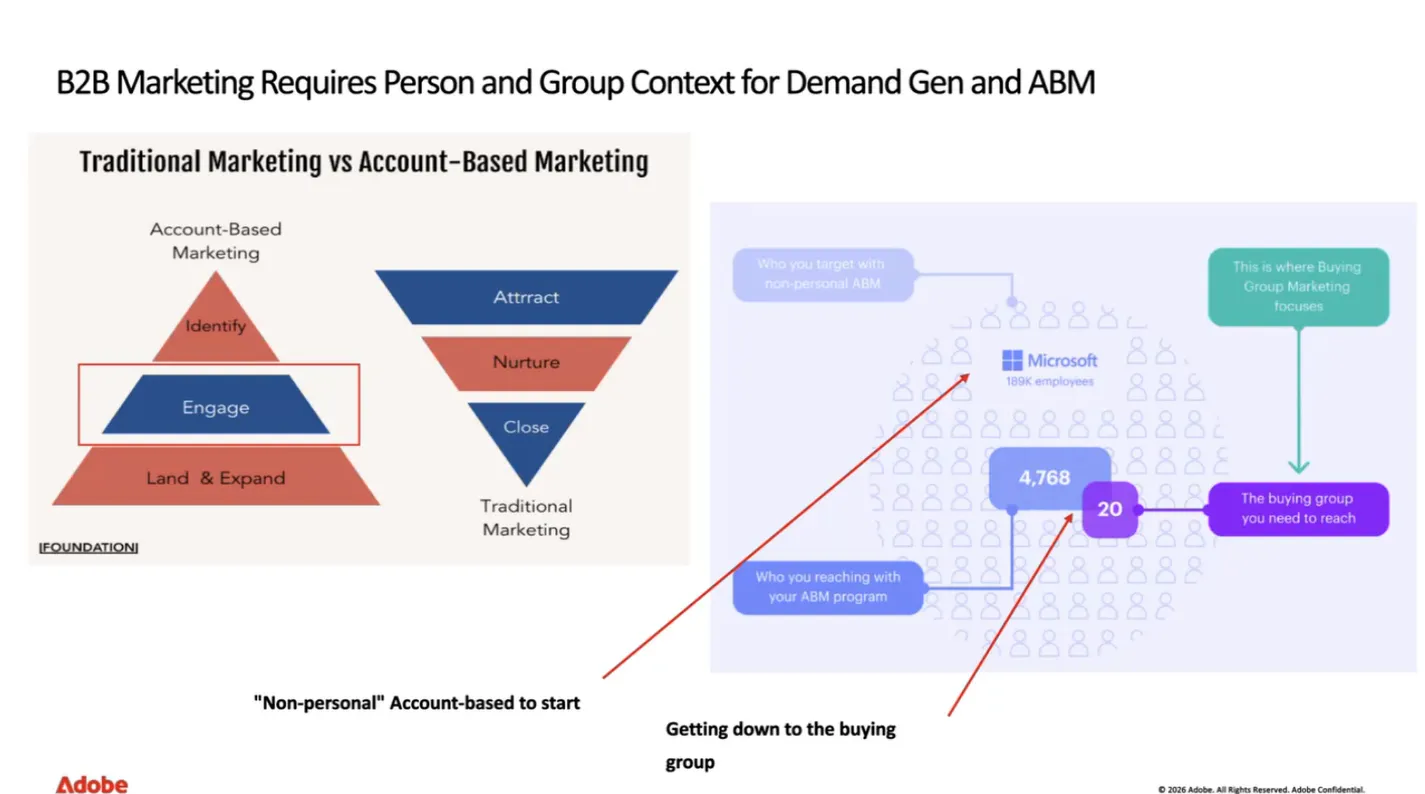
After identifying target accounts, the key ABM challenge is growing the list of relevant people inside those organizations. Large companies may have thousands of employees, but only a small subset—defined by role, department, and influence—forms the actual buying group. These individuals are few but highly valuable, as each represents a potentially large deal.
This approach explains why Real-Time Customer Data Platforms (CDPs) are built around both individual (lead-based) profiles and account-based profiles. While CDPs have long focused on individuals, support for account-level data is relatively recent in B2B marketing. Today, CDPs increasingly enable activation of both people and accounts, though there are still fewer destinations that can accept account-level data, especially for advertising.
There is a complexity of B2B buying journeys, where different roles engage at different times and through different channels. The goal is to make members of the buying group known earlier in the funnel.
ABM is now mainstream
Account-Based Marketing (ABM) is now mainstream and widely adopted across B2B organizations. Because ABM is broadly recognized as a high‑ROI, “no‑brainer” strategy, the challenge is no longer to justify doing ABM, but rather to justify improving how ABM is executed.
Research highlights three key challenges in ABM:
- Data accuracy, especially due to reliance on third‑party data
- Attribution, understanding which engagements (such as ads) actually drove conversion
- Pipeline effectiveness, connecting early marketing interactions to final revenue outcomes
Real-Time CDP directly addresses these challenges by improving data quality, attribution, and pipeline visibility.
Finally, ABM advertising is called out as a particularly effective tactic, making it a strong area where CDP can add value by powering and optimizing ABM-focused advertising execution.