Brand Presence Optimization
The Challenge
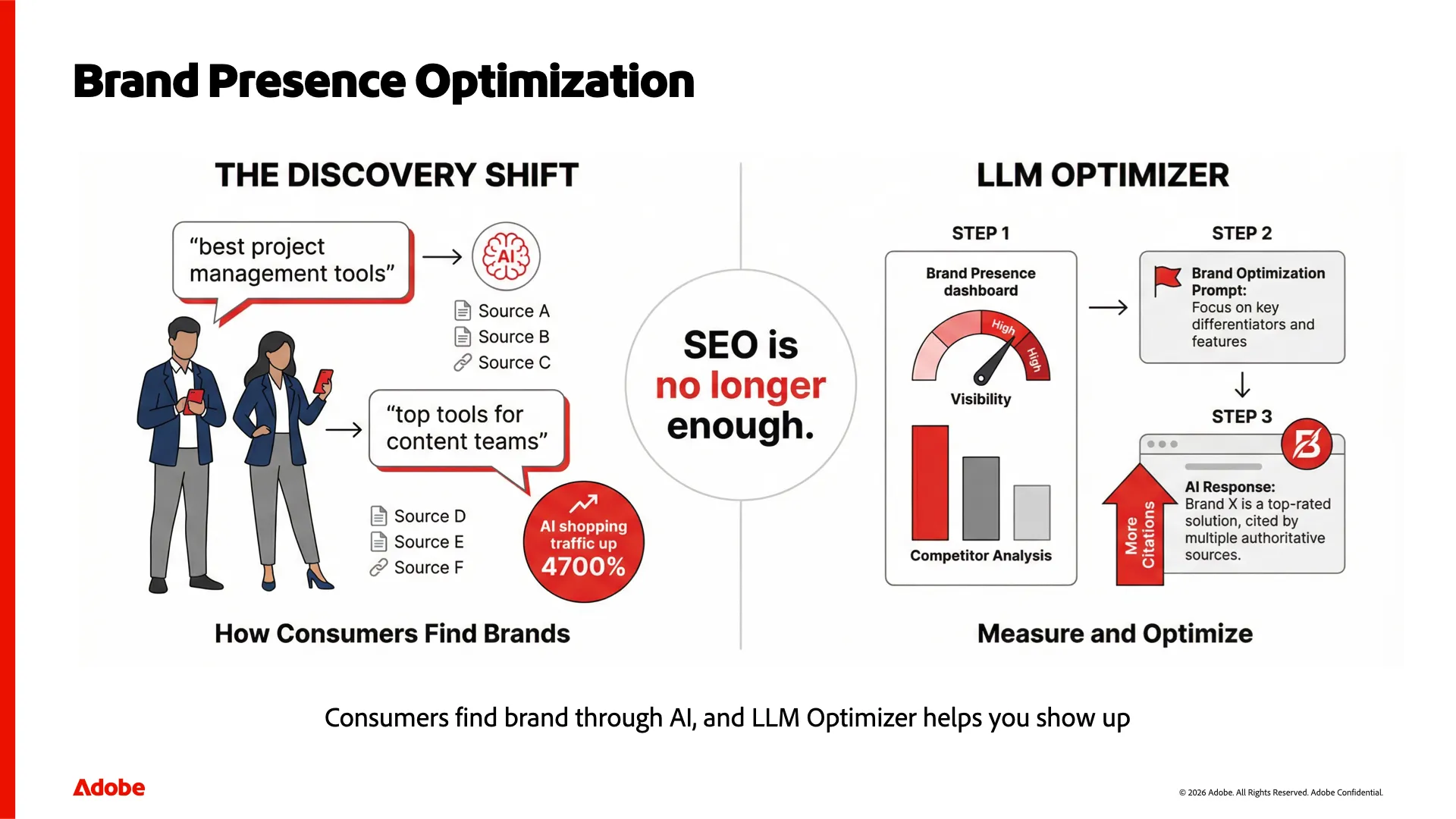
The way consumers discover brands is fundamentally shifting. AI-powered search tools like ChatGPT, Gemini, and Perplexity are rapidly replacing traditional search as the starting point for product research, purchasing decisions, and brand evaluation. Traditional SEO alone is no longer sufficient.
Organic search traffic is declining as consumers increasingly start their research in AI tools rather than traditional search engines. At the same time, the overlap between AI citations and traditional search rankings is minimal, meaning brands optimized solely for Google are largely invisible in AI-generated answers.
The result: Brands that lack a Generative Engine Optimization (GEO) strategy risk losing visibility, share of voice, and ultimately revenue as consumers shift to AI-first discovery. Content rendered via JavaScript frameworks (React, Angular, Vue) is completely invisible to LLMs, compounding the problem for modern web properties.
What You'll Explore
- AI Search Landscape and How LLMs Work - Understand the fundamental shift from SEO to GEO and how large language models generate responses. See how LLMs process queries, generate fan-out queries, retrieve web content, and synthesize responses with citations. Learn why JavaScript-rendered content is invisible to AI agents and how to diagnose readability gaps.
- Key Metrics and Brand Presence Analysis - Explore LLM Optimizer's core metrics, including visibility scores, mentions, citations, share of voice, and sentiment. Learn how to interpret the Brand Presence dashboard, analyze competitive positioning, and identify high-priority topics where your brand is underperforming.
- Prompt Strategy Development - Experience consumer-centric prompt creation that goes beyond marketer thinking. Develop branded, non-branded, comparison, problem-solving, and negative sentiment prompts using sources like Google "People Also Ask," Reddit, customer service inquiries, and sales team feedback.
- Optimization and Action Planning - Discover automatically detected optimization opportunities, from technical fixes and content improvements to off-site strategies. Learn how edge optimization enables rapid deployment at the CDN layer without CMS changes, and build a prioritized action plan with clear metrics and review cadence.
AI Capabilities in Focus
Capability | What It Does |
|---|---|
AI Readability Analysis | Diagnoses how much of your site content is visible to AI agents versus hidden by JavaScript rendering |
Visibility Scoring | Weighted calculation combining mentions, citations, position, and sentiment into a single benchmark |
Share of Voice Tracking | Measures how often AI references your brand versus competitors across topics and platforms |
Automated Opportunity Detection | Identifies and prioritizes optimization opportunities based on topic popularity, competitive gaps, and performance |
Primary Solutions
- Adobe LLM Optimizer: End-to-end platform for monitoring and optimizing brand presence across AI search platforms
- AI Readability Checker: Free Chrome extension for diagnosing content visibility to AI agents
Best For
This module is well-suited for organizations that:
- Are experiencing declining organic search traffic and need to understand AI-driven discovery
- Want to measure and improve their brand's visibility in AI-generated responses
- Need competitive intelligence on how AI platforms reference their brand versus competitors
- Have JavaScript-heavy websites that may be invisible to LLMs
- Seek to develop a dual SEO + GEO strategy with clear metrics and review cadence
Audience Considerations
Audience | Focus Areas |
|---|---|
Marketing Managers | Prompt strategy, brand presence analysis, action planning |
SEO Analysts | GEO strategy, technical optimization, AI readability diagnostics |
Content Strategists | Consumer-centric prompt development, content gap analysis, off-site optimization |
Digital Teams | Platform-specific strategies, edge optimization, competitive benchmarking |
Sample Hands-On Exercises
Depending on engagement depth, participants may:
- Install the AI Readability Checker and compare agent view versus human view on key pages
- Develop branded, non-branded, and competitive prompts using consumer-centric thinking
- Configure categories, topics, prompts, competitors, and brand aliases in LLM Optimizer
- Analyze Brand Presence data to identify high-priority topics and competitive gaps
- Review the Opportunities dashboard and build a prioritized GEO action plan with timelines
Workshop Format
This module is delivered as a two-part workshop series, with sessions recommended approximately one week apart:
- Part 1 (90 min): Prompt Best Practices and Configuration, covering AI search fundamentals, key metrics, prompt strategy, and initial LLM Optimizer setup
- Part 2 (90 min): Brand Presence Review and Analysis, covering dashboard orientation, competitive analysis, optimization opportunities, and action planning
Related Modules
Commonly paired with:
- Workflow Planning & VisibilityWorkflow Planning & Visibility: Integrate GEO strategy into campaign planning and content operations
- Multi-Channel Web DeliveryMulti-Channel Web Delivery: Follow assets from discovery through personalized delivery
Prerequisites
For customer experience lab engagements, participants benefit from:
- Laptop with Chrome or Edge browser for the AI Readability Checker extension
- A list of 2-5 key competitors to track
- Knowledge of business categories and product/service lines for configuration
- (Recommended) Cross-functional attendance from marketing, SEO, content, and digital teams